
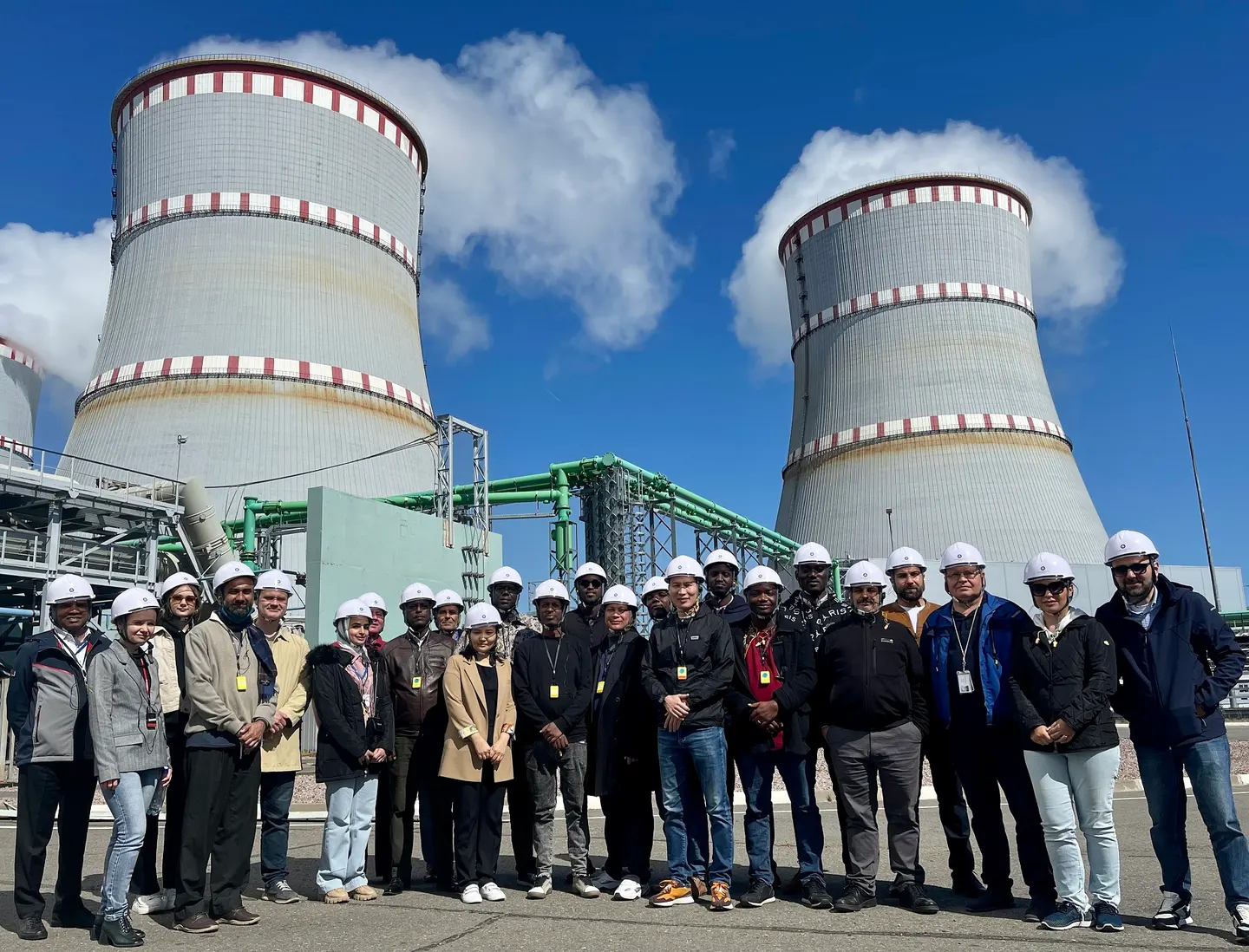
On June 05-09, the St Petersburg branch of the Rosatom Technical Academy hosted the Russian Federation-IAEA Advanced Nuclear Energy Management School. It has been conducted within the framework of the Agreement between Rosatom and the IAEA on the extra-budgetary contribution of the Russian Federation to Technical Cooperation projects for the development of nuclear infrastructure in newcomer countries.
The School involved 27 participants from 15 countries, including Armenia, Bangladesh, Brazil, Belarus, Ghana, Egypt, Jordan, Iran, Laos, Mongolia, Nigeria, Rwanda, Russia, Uzbekistan, and Ethiopia.
 The program of the School was devoted to provide training on topical subjects related to nuclear energy to support senior managers in the nuclear sector in building and enhancing the managerial and leadership competencies essential for establishing, expending, and managing national nuclear programmes. The aim of the School is to give middle managers in the nuclear industry and the Governments of the IAEA member States a broad understanding of the key issues and challenges associated with the use of nuclear technologies for peaceful purposes.
Mr Ashok Ganesan, specialist of the Division of Planning, Information and Knowledge Management of the IAEA Nuclear Energy Department, and Mr Viktor Mazepov, Director of the Center for International Cooperation of the Rosatom Technical Academy, opened the School with their welcoming speeches.
The School programme was traditionally aimed at deepening knowledge in nuclear licensing and regulation, nuclear energy policy, safety culture, nuclear fuel cycle, nuclear safety and security, nuclear safeguards, emergency preparedness and response, export control, sustainable development goals and other areas.
This year, the IAEA experts paid special attention to its assistance for Member States in addressing all relevant nuclear infrastructure issues and talked about the Milestones Approach and its set of activities necessary to establish the nuclear infrastructure in countries that are considering or planning their first nuclear power plant.
Thus, Ms Liliya Dulinets, Head of Nuclear Infrastructure Development Section, talked about a set of responsibilities, functions and activities that States can use as guidance for establishing a nuclear energy programme implementing organization (NEPIO). Ms Judit Silye, Legal Officer of the Nuclear and Treaty Law Section, the IAEA Office of Legal Affairs, introduced participants to nuclear law and international legal instruments, and paid attention to the development of a national nuclear legislation system.
Lectures, panel discussions and an open dialogue with Russian and international experts contributed to debating and understanding of key issues and problems related to management and leadership in the implementation of national nuclear energy programmes. The theoretical training was supported by the practical part. For example, Mr Saied Dardour, energy economist of the Planning and Economic Studies Section, Division of Planning, Information and Knowledge Management, moderated a game where the participants were asked to determine the structure of electricity production in the country, optimizing it in terms of reducing carbon dioxide emissions and reliability of supplies using the PowerInvest tool.
The participants also had the opportunity to visit the Leningrad NPP, organized to get acquainted with Russian technologies and gain experience in the operation of the nuclear power plant. The tour began with the Training Center with a unique full-scale simulator. Then the participants visited the site of the 6th power unit VVER-1200: saw the splash pools, visited the turbine building, and also studied the principle of operation of cooling towers.
At the end of the School, all participants received certificates of successful completion of training.
For reference:
The expansion of the use of nuclear energy and technology creates an ever-growing need worldwide for highly qualified specialists in the field of nuclear energy with appropriate technical and managerial skills. The IAEA conducts the Nuclear Energy Management Schools which help Member States train specialists in the management of nuclear energy and nuclear applications programmes.
Joint Russia-IAEA Nuclear Energy Management Schools have been held annually since 2016. This School became the eighth in the treasury of the Rosatom Technical Academy. A joint Russia-IAEA Nuclear Knowledge Management School is scheduled to be held in Moscow on August 07-11.
