
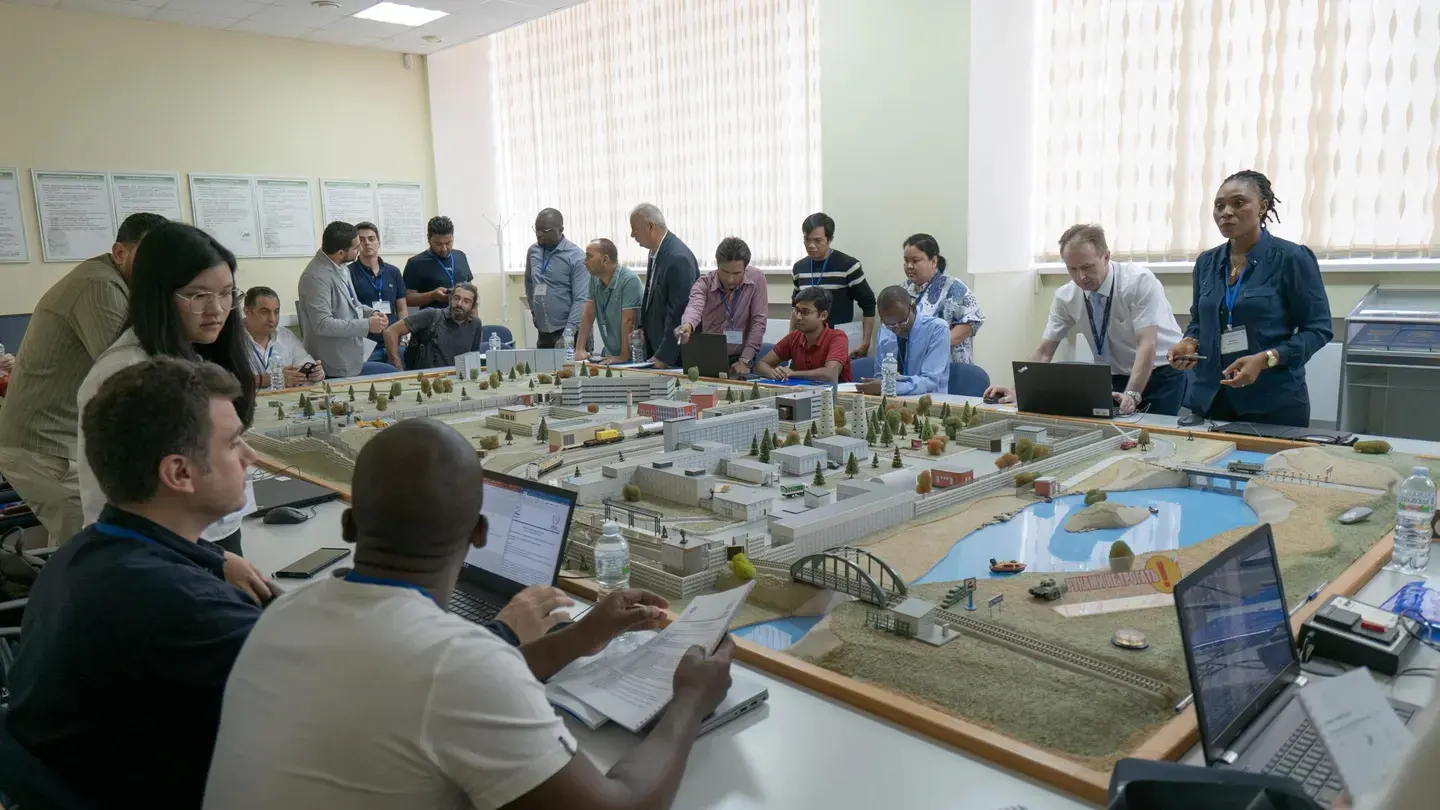
The training course on operation of physical protection systems at nuclear facilities organized in cooperation with the IAEA was completed at Rosatom Technical Academy. The Course was attended by 30 specialists from 18 countries.
During seven days, leading IAEA experts, Rostechnadzor specialists and instructors from the Global Nuclear Safety and Security Institute of Rosatom Technical Academy introduced the trainees to the main international documents in the field of nuclear security, the principles of design basis threat, graded approach to nuclear security and other IAEA basic principles reflecting the world’s best practices.
In the course of practical training, foreign specialists were introduced to the basic principles of operation of engineering and technical physical protection means installed at nuclear facilities. The students were able to consolidate their knowledge through group work at a hypothetical nuclear facility “Hypotron”, allowing them to assess the effectiveness and sufficiency of existing nuclear security measures and propose their conceptual solutions to improve the nuclear security of the facility in order to comply with international conventions and IAEA recommendations.
According to Vivian Ojibo, an operator of the Nigeria Atomic Energy Commission and a trainee of the course, scientific work and training of specialists are being carried out in Nigeria on the basis of the research reactor. The second nuclear reactor for the development of nuclear medicine and radioecology is being created, and the construction of the country’s first nuclear power plant is planned.
“It is very important for us to continuously improve nuclear security. An international IAEA IPPAS mission recommended additional training for Nigerian specialists in the field of physical protection. This is how I became a participant of this course in Russia, and now the important points related to nuclear security and the principles of organizing physical protection systems are clear to me,” said Vivian Ojibo.
“Brazil has quite an extensive experience in developing nuclear energy,” shared Luis Otávio De Oliveira, an expert of Brazil’s National Nuclear Energy Commission. “But it is important for us to learn new things from other countries and to share ideas. During the courses in Russia, we had many discussions with representatives from Turkey and Egypt. We will be able to apply useful knowledge gained form the instructors at our facilities. I work at a research reactor. Once I get home, I’ll make a presentation summarizing everything that I’ve learned here. I am completely confident that we will launch the process of improvement.”
For reference:
Nuclear security training courses are conducted within the framework of the voluntary contribution of the Russian Federation to the IAEA’s Nuclear Security Fund and combine advanced theoretical fundamentals of physical protection with applied practical modules.
Practical training is held on the premises of modern testing grounds and laboratories of the Global Nuclear Safety and Security Institute of Rosatom Technical Academy, leading educational institution of Rosatom State Corporation for training specialists of state bodies and nuclear and radiation hazardous facilities in Russia and abroad.
GNSSI’s instructors have an extensive practical experience in training Russian and foreign specialists in the field of security. In 2024, 5 training courses are to be conducted as part of the contribution.
Russia is actively developing cooperation with foreign countries. Major joint energy projects continue to be implemented. Rosatom and its divisions take an active part in this work.